Personal Finance Outlook 2026: Key Strategies for Building Wealth

Building wealth in the 2026 personal finance landscape requires proactive strategies, including diversified investments, astute inflation management, and continuous adaptation to evolving economic and technological trends.
Navigating the complex world of personal finance can feel overwhelming, but understanding the Personal Finance Outlook 2026 offers a clear roadmap. This guide will equip you with essential strategies to build and preserve wealth, ensuring your financial future remains robust amidst ongoing economic shifts and emerging opportunities.
Understanding the 2026 Economic Landscape
The economic environment of 2026 is shaped by a confluence of factors, including technological advancements, geopolitical shifts, and evolving consumer behaviors. These elements collectively influence inflation rates, interest rate policies, and overall market volatility, making it crucial for individuals to stay informed and adaptable.
Global supply chains continue to reconfigure, impacting pricing and availability of goods. The push towards sustainable practices also introduces new investment avenues and potential regulatory changes. Understanding these macro trends is the first step in formulating effective personal finance strategies.
Inflation and Interest Rates: A Balancing Act
Inflationary pressures, while potentially moderating, remain a significant concern. Central banks globally are expected to continue their delicate balancing act, using interest rate adjustments to curb inflation without stifling economic growth. For personal finance, this means higher borrowing costs but also potentially better returns on savings.
- Monitor central bank announcements closely.
- Understand how interest rate changes affect your mortgage and loan payments.
- Explore high-yield savings accounts and short-term bonds.
Technological Disruption and Market Dynamics
Artificial intelligence, blockchain, and other emerging technologies are not just transforming industries; they are also creating new investment opportunities and reshaping market dynamics. These innovations can lead to rapid shifts in stock valuations and the emergence of entirely new sectors, demanding a forward-looking investment approach.
In essence, the 2026 economic landscape requires a nuanced understanding of both traditional economic indicators and the disruptive forces of innovation. Successful wealth building will hinge on the ability to anticipate and respond to these dynamic conditions.
Diversifying Your Investment Portfolio for Resilience
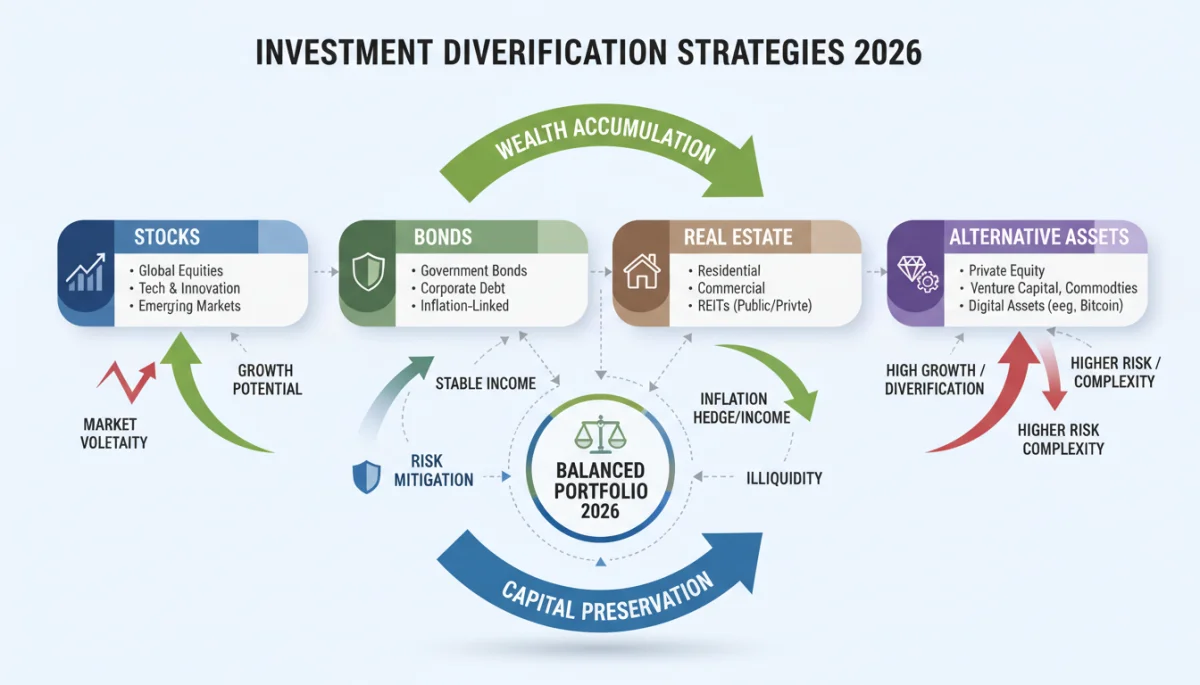
Diversification is not merely a buzzword; it is a foundational principle for building a resilient investment portfolio, especially in the volatile economic climate projected for 2026. Spreading investments across various asset classes helps mitigate risk and enhance long-term returns.
A well-diversified portfolio acts as a buffer against market downturns in any single sector. It ensures that even if one area performs poorly, other investments can potentially offset those losses, maintaining overall portfolio stability and growth.
Traditional Assets: Stocks and Bonds
While new asset classes emerge, traditional stocks and bonds remain cornerstones of many portfolios. For 2026, a strategic allocation between these two will be vital. Equity markets may see continued volatility, necessitating a focus on fundamentally strong companies with clear growth trajectories.
- Prioritize companies with robust balance sheets and sustainable business models.
- Consider dividend-paying stocks for income generation.
- Allocate to high-quality bonds for stability and capital preservation.
Alternative Investments: Real Estate and Digital Assets
Beyond traditional assets, alternative investments offer unique diversification benefits. Real estate, both physical and through REITs, can provide inflation hedging and rental income. Digital assets, including cryptocurrencies and NFTs, though highly volatile, represent a growing segment of the investment landscape.
Investing in alternative assets requires thorough research and a clear understanding of their inherent risks. They can offer significant returns but also carry higher levels of uncertainty compared to more established asset classes. Investors should consider these carefully within their overall risk tolerance.
Ultimately, a diversified portfolio for 2026 is one that thoughtfully blends traditional stability with opportunistic exposure to growth sectors, ensuring adaptability to various market conditions.
Leveraging Technology for Financial Advantage
The rapid advancement of technology continues to revolutionize personal finance, offering unprecedented tools and opportunities for managing money, making informed decisions, and growing wealth. Embracing these technological innovations is no longer optional but essential for staying competitive in the 2026 financial landscape.
From AI-powered financial advisors to blockchain-enabled transactions, technology provides greater transparency, efficiency, and accessibility to financial services. Understanding and utilizing these tools can significantly enhance your financial planning and investment strategies.
Robo-Advisors and AI in Investing
Robo-advisors, powered by artificial intelligence and sophisticated algorithms, are becoming increasingly popular for their cost-effectiveness and personalized investment strategies. They can automate portfolio rebalancing, tax-loss harvesting, and provide tailored advice based on individual risk profiles and financial goals.
- Utilize robo-advisors for automated, low-cost investment management.
- Explore AI-driven insights for market analysis and trend prediction.
- Ensure the chosen platform aligns with your financial objectives and security preferences.
Blockchain and Decentralized Finance (DeFi)
Blockchain technology and decentralized finance (DeFi) are disrupting traditional banking and financial systems by offering peer-to-peer transactions, lending, and borrowing without intermediaries. While still nascent and volatile, DeFi presents innovative ways to potentially earn yield and manage assets.
Engaging with DeFi requires a strong understanding of the underlying technology and associated risks. However, for those willing to learn, it offers a glimpse into the future of finance and new avenues for wealth creation. Security and regulatory clarity remain evolving aspects of this space.
Harnessing technology effectively means not just adopting new tools but also understanding their implications for security, privacy, and long-term financial strategy. It’s about making smart, informed choices in a digitally evolving world.
Strategic Tax Planning and Estate Management
Effective tax planning and meticulous estate management are critical components of a comprehensive wealth-building strategy, particularly as we look towards 2026. These areas, often overlooked, can significantly impact your net worth and ensure your legacy is preserved according to your wishes.
Tax laws are subject to change, and staying abreast of these developments can unlock considerable savings. Similarly, a well-structured estate plan provides peace of mind and minimizes potential disputes or financial burdens for your beneficiaries.
Optimizing Tax Efficiency in Investments
Beyond simply filing taxes, strategic tax planning involves making investment decisions that reduce your overall tax burden. This includes utilizing tax-advantaged accounts like 401(k)s, IRAs, and HSAs, as well as understanding capital gains taxes.
- Maximize contributions to tax-deferred retirement accounts.
- Consider tax-loss harvesting to offset capital gains.
- Explore municipal bonds for tax-exempt income, depending on your state of residence.
Estate Planning for Future Generations
Estate planning is not just for the wealthy; it’s for anyone who wishes to control how their assets are distributed and who will care for their dependents. This involves drafting wills, establishing trusts, and designating beneficiaries for all financial accounts.
In 2026, with potential shifts in estate tax laws and increasing complexity in digital assets, reviewing and updating your estate plan regularly is more important than ever. Consulting with an estate planning attorney ensures your plan is legally sound and reflects your current wishes.
By proactively addressing tax and estate matters, individuals can significantly enhance their long-term financial security and ensure a smooth transition of wealth across generations.
Building and Maintaining Financial Health
True wealth building extends beyond investment returns; it encompasses a holistic approach to financial health, including disciplined budgeting, debt management, and robust emergency savings. These foundational elements provide stability and flexibility, crucial for navigating unforeseen financial challenges in 2026 and beyond.
A strong financial foundation allows you to take advantage of investment opportunities without being crippled by unexpected expenses or market volatility. It’s about creating a sustainable financial ecosystem that supports your long-term goals.
Budgeting and Expense Management
A well-defined budget is the cornerstone of financial health. It provides a clear picture of your income and expenditures, enabling you to identify areas for savings and ensure your spending aligns with your financial goals. Technology offers numerous apps and tools to simplify this process.
Regularly reviewing your budget helps you adapt to changing income levels or unexpected expenses. It also fosters a sense of control over your finances, reducing financial stress and promoting intentional spending.
Debt Reduction and Credit Score Optimization
High-interest debt can be a significant impediment to wealth accumulation. Prioritizing debt reduction, especially on credit cards and personal loans, frees up capital that can be directed towards savings and investments. Simultaneously, maintaining a strong credit score is vital for accessing favorable lending rates for mortgages and other necessary loans.
- Focus on paying down high-interest debt first.
- Automate debt payments to avoid late fees and maintain consistency.
- Regularly check your credit report for errors and monitor your score.
Emergency Savings and Risk Management
An emergency fund, typically covering three to six months of living expenses, is non-negotiable. It acts as a financial safety net, protecting your investments from being liquidated prematurely during crises. Alongside savings, assessing and managing risks through appropriate insurance coverage is equally important.
This includes health insurance, life insurance, and property insurance, tailored to your specific circumstances. Being prepared for the unexpected is a key component of financial resilience and prudent wealth management.
Future-Proofing Your Personal Finances
As we advance towards 2026, the concept of future-proofing personal finances becomes increasingly relevant. This involves not only adapting to current trends but also anticipating future shifts in the economy, technology, and society to ensure long-term financial stability and growth.
Future-proofing requires a proactive mindset, continuous learning, and a willingness to evolve your financial strategies. It’s about building a financial framework that can withstand unforeseen challenges and capitalize on emerging opportunities.
Continuous Learning and Skill Development
The job market and investment landscape are constantly evolving. Investing in your own education and skill development ensures you remain employable and can adapt to new economic realities. This could involve learning new technologies, acquiring certifications, or even pursuing higher education.
Financial literacy itself is a crucial skill. Staying informed about market trends, economic forecasts, and new financial products empowers you to make smarter decisions and avoid costly mistakes. Lifelong learning is an investment in your human capital.
Adapting to Global and Local Economic Shifts
Global events, from geopolitical tensions to climate change, can have profound impacts on local economies and investment markets. A future-proof financial plan considers these broader influences and builds in flexibility to respond effectively. This might mean diversifying geographically or investing in sectors resilient to certain global challenges.
- Stay informed about international economic news and its potential impact.
- Consider global diversification in your investment portfolio.
- Support local businesses and understand regional economic drivers.
Embracing Sustainable and Ethical Investing
Environmental, Social, and Governance (ESG) investing is gaining significant traction and is expected to be a major force in 2026. Aligning your investments with your values can not only contribute to a better world but also potentially offer strong financial returns as more companies prioritize sustainability and ethical practices.
Future-proofing your finances is an ongoing process that demands vigilance, adaptability, and a commitment to continuous improvement. By embracing these principles, you can build wealth that is robust, resilient, and ready for whatever the future holds.
| Key Strategy | Brief Description |
|---|---|
| Diversified Investments | Spread assets across various classes to mitigate risk and capture diverse growth opportunities. |
| Leverage Technology | Utilize AI, robo-advisors, and fintech tools for smarter financial management and investing. |
| Strategic Tax Planning | Optimize tax efficiency through deductions, credits, and tax-advantaged accounts to maximize net returns. |
| Future-Proofing Finances | Adopt continuous learning and adaptability to navigate evolving economic and technological landscapes. |
Frequently Asked Questions About 2026 Personal Finance
The primary challenges include managing persistent inflation, navigating fluctuating interest rates, and adapting to global economic uncertainties. Geopolitical shifts and supply chain disruptions also contribute to market volatility, requiring prudent financial planning and diversified investment strategies to mitigate risks.
Technology offers advanced tools like AI-powered robo-advisors for automated investing and personalized advice, budgeting apps for better expense tracking, and blockchain for secure transactions. These innovations enhance efficiency, provide deeper insights, and make sophisticated financial management more accessible to everyone.
Real estate can remain a valuable component of a diversified portfolio in 2026, offering potential for appreciation and rental income. However, local market conditions, interest rates, and inflation will significantly influence its profitability. Thorough research and a long-term perspective are essential for successful real estate investments.
Continuous learning is crucial for future-proofing your finances. Staying informed about economic trends, new technologies, and evolving financial products allows you to adapt your strategies effectively. Investing in financial literacy and skill development ensures you can capitalize on new opportunities and navigate challenges successfully.
Tax planning is exceptionally important. Strategic tax management, including utilizing tax-advantaged accounts and understanding capital gains, can significantly reduce your tax burden and maximize your net returns. Proactive planning helps preserve more of your wealth, contributing substantially to long-term financial growth.
Conclusion
The Personal Finance Outlook 2026 underscores the importance of an adaptable, informed, and proactive approach to wealth building. By understanding the economic landscape, embracing diversified investment strategies, leveraging technological advancements, and prioritizing diligent financial health practices, individuals can confidently navigate the complexities of the future. The journey to financial security and prosperity in 2026 and beyond is not about predicting every market turn, but about building a resilient framework that can withstand change and seize new opportunities.
